Features

“F*ck you, we’re going to win because love is more important than hate”: Inside Puscifer’s new normal

The world is falling apart all around us, but Maynard James Keenan hasn’t given up hope just yet. As he reunites with his Puscifer bandmates Carina Round and Mat Mitchell for new album Normal Isn’t, we get their thoughts on everything from misery to mudslides and manscaping…

“F*ck you, we’re going to win because love is more important than hate”: Inside Puscifer’s new normal
Words:
George Garner
Photos:
Travis Shinn

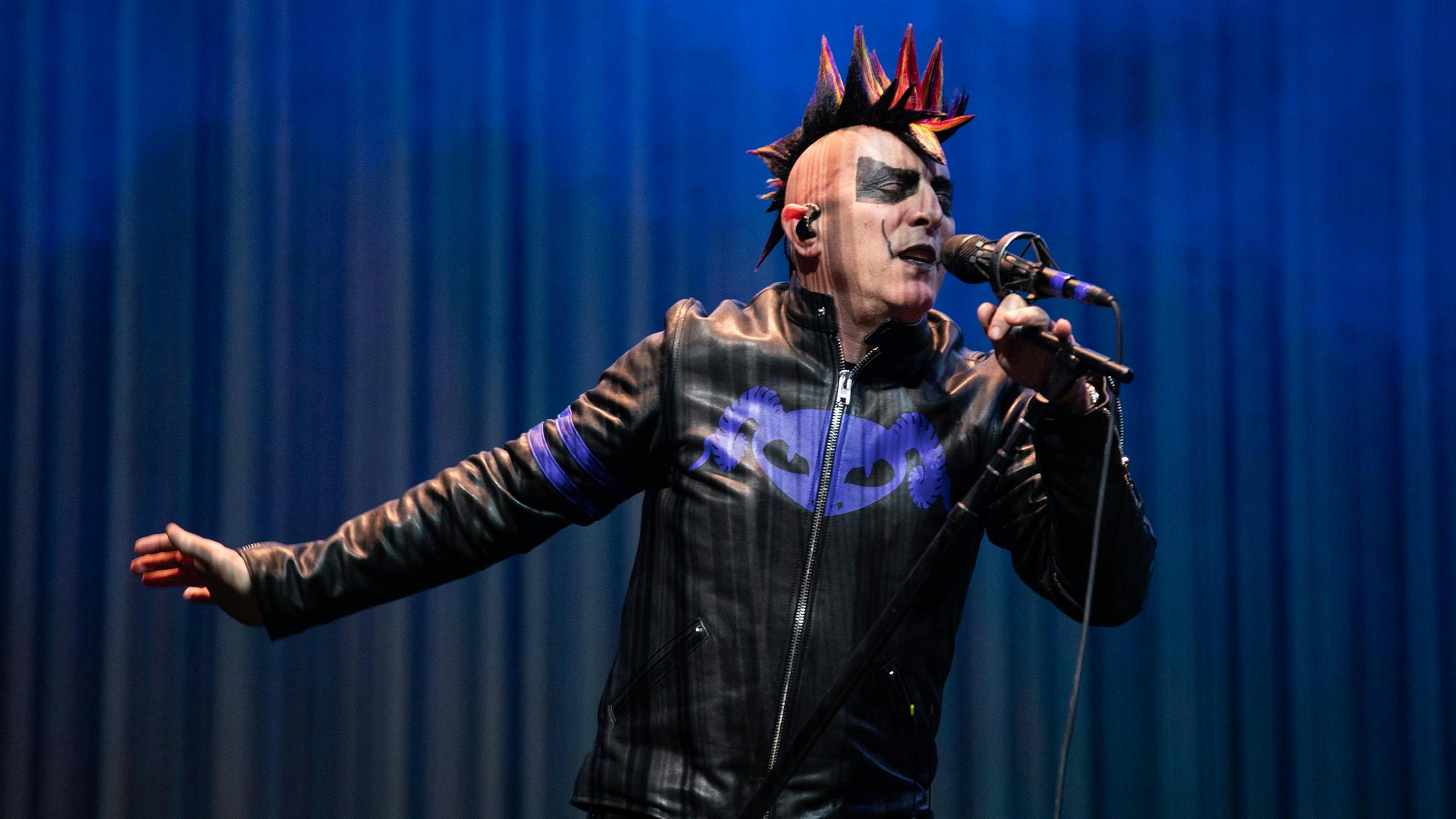
“Don’t be a hippo-twatamus.” These are the words emblazoned on a mug that Maynard James Keenan has angled to directly face Kerrang! at his Arizona home as we start our interview. Not only is that maxim – displayed above a smiling purple hippo – great advice, it could well have doubled-up as a title for Puscifer’s excellent new album. Instead, they landed on the similarly compelling name Normal Isn’t. As in… Normality is dead. The world has ceased to be normal, and the same goes for everyone living in it. Including you, pal. This is what Puscifer – completed by Carina Round and Mat Mitchell – are reporting on this time around: a world operating at the outermost reaches of absurdity.

“It’s every fucking day, right?” Maynard begins, explaining why Puscifer are making this particular diagnosis now. “When, as a reasonable person, you see and point out an almost-train wreck and you’re told you’re being paranoid, and then you’re actually witnessing it happen in real time, you almost go, ‘Cheers…’”

For much of our conversation Maynard leans on one arm, his fist pressed into his temple, but here he breaks his stance, looking over his shoulder quickly out of the window, almost as if he’s hearing trouble outside.

“I might have to take a break in the middle of this interview,” he quips. “I think we’re going to end up invading Mexico, I’ll get back to you. Fucking insanity. Come on, man, it’s just insane. You’ve got all this disruption and weird shit going on here, and then shit everywhere else. It just feels like it has to come to its own breaking point, burn to the ground and start over, I guess.”

Those complicit in driving us towards that breaking point don’t get off easy on Normal Isn’t.

Maynard’s never been one to suffer fools gladly, but he gladly makes fools suffer. The album features scathing takedowns, with Self-Evident seeing him start off by labelling someone a ‘bunghole’ before working his way through to insults like ‘skid mark prat’ and ‘twit’.

Elsewhere, it’s a record that diagnoses and challenges the archetypes complicit in our mutual downfall in a number of ways, with Public Stoning addressing people who are addicted to their own unchallenged truths…

“Nobody is 100 per cent win, win, win, win,” says Maynard. “We don’t all – and can’t all – think alike. That’s absolutely insane if you’re just living in an echo chamber, sniffing your own farts with your buddies. The echo chamber idea gets you in a loop, and you can’t have normal conversations with people, for fuck’s sake.”

Another archetype of our mutual misery is addressed on ManTastic, a song inspired, at least partly, by pubic hair.

“I was watching UFC and they’re sponsored by all these weird fucking things, and one was manscaping,” Maynard says. “Then I had to listen to a bunch of fucking alpha male douchebags talk about how they’re alpha maley, right? And it’s like, ‘Don’t you fucking wax your balls? Like, you’re manscaping and carving up your fucking pubes.’ I want to watch you explain the fucking alpha maleism of waxing. I don’t know. I think it’s just this weird tribalism, in a way, this, ‘(Puts on macho voice) What kind of creatine are you drinking?’ It’s a weird caricature of ourselves.”

With humanity rapidly morphing into a gigantic clown shoe, drastic times call for drastic measures. And sounds. Normal Isn’t sonically pivots this already most chameleonic of bands into new territory, drawing from post-punk, new wave and goth, with each Puscifer member even sharing a soundtrack of personal influences to set the mood. Throbbing Gristle. New Order. The Cure. Cocteau Twins. Siouxsie & The Banshees. Bauhaus. All appear, and more besides.

“It was fun to put it out,” says Puscifer multi-instrumentalist extraordinaire Mat Mitchell, reaching K! from a purple-bathed neon studio in LA. “I mean, it was even fun for me to look and see what Carina and Maynard had put on it. These are people that inspire us and deserve recognition – not that any of them need any more recognition, but it’s nice to pat people on the back when they’re inspiring you.”

Perhaps unsurprisingly, then, things get experimental on Normal Isn’t, with help drafted in from Tony Levin (King Crimson), Greg Edwards (Failure) and Sarah Jones (Bloc Party, Hot Chip), while Seven One even features Tool’s Danny Carey on drums and Atticus Ross’ dad, Ian, narrating it. Part of the experimentalism this time around also comes from Maynard getting more involved by learning how to do things in the studio himself, courtesy of Mat teaching him some tricks.

Mat’s verdict on Maynard’s performance as a student?

“He’s a pro!”

As for Maynard’s own self-evaluation? Well, he recalls conversations that often went like this.

Maynard: “Heeeeeeeey, remember when you taught me how to do that thing with the thing and then I went on to the thing?”

Mat: “Uh-huh.”

Maynard: “Can you start over and tell me again?”

Mat: “Uh-huh.’”

Still, presumably after a bunch of uh-huhs, Puscifer have ended up with a brilliant record, and one accompanied with a comic series shedding light on the arrival of their new characters, all adding depth and humour to this chapter. There’s the exsanguinated Bellendia (pronounced Belleeeendiaaaaaahhhhh, as he stressed to Maynard in their recent strained YouTube interview) as well as Fanny Gray and the Synth Whisperer. And there is still a hell of a lot to get into.

Here, Maynard and Mat guide us through the predicament of our present, the pain of our past, phalluses mounted on household appliances, and how the band who came to life back in 2007 with a record called V Is For Vagina have now come to stand for L Is For Longevity…

Let’s get into opening song Thrust and its refrain ‘Trying not to murder’s a daily fucking battle’. Is that just an accumulation of feeling building up inside you, or was there a particular inciting moment behind it à la, say, Michael Douglas’ character in Falling Down?
Maynard James Keenan:
“Yeah, that poor bastard. But, in his case, he was already mentally ill to begin with. The flaw of that movie is that he was already unhinged. If that movie had pushed him over the edge, having never been unhinged, it would have been a more effective film. In that respect, I think there are a lot of people that are equally building up that frustration over time. I guess there’s a generational thing, too. If you have generational trauma, it shows up in some way – it shows up in your kids, and it takes a few generations of there being no trauma to work that out of their system. I’ve seen some of the research and I think there is some truth to generational insanity.”

It’s interesting that in a song about societal disintegration, Maynard’s own vocals start to, well, disintegrate into mumbling at one point, too…
Mat Mitchell:
“That was a very creative moment. That song is so disjointed for a good portion of it, and then for it lyrically and melodically to become just as disjointed and have its components fall to the floor, it’s just really cool.”

Maynard, is it just us or have you paid real attention to rhyming on this album – the lyrics are full of tongue twisters and alliteration?
Maynard:
“Yeah, all those fucking things! I had to use a teleprompter when we filmed it for the for the concert, because I couldn’t fucking remember the fucking words.”

It begs the question: why make things so hard for yourself when you already have tough notes to hit?
Maynard:
“Because it’s a challenge. Fuck it. Let’s rise to it. Push your boundaries. So I did, and then I’m like, ‘Why the fuck did I fucking push my boundaries – just fucking enjoy your retirement!’ A lot of it is written as a scat to begin with, so I know my mouth can do it. Then you assign syllables to that map, and remember them. That’s the hard part… Remembering. I’ve had friends be like, ‘Hey, man, you should do some acting.’ But I would be the worst because I can’t remember lines. I can completely develop a character and what would be in line with them, but hand me a set of lines? My brain just fucking freezes. And here I am with my own fucking lines, and I can’t fucking remember them.”

And to think, Carina also has to learn them now. She deserves a lot of praise for her vocal performance on this album – she has some stunning moments on it…
Mat:
“Carina, I think, has the hardest job because she’s got Maynard coming at her and she’s got to sing a lot of those things that he’s coming up with, and then find a space where she’s not just reinforcing something, but taking the songs and making them better and creating new parts. She’s a vocal gymnast, super-creative and always makes things better than they were. You always get back more than you were expecting.”

What did Mat and Carina bring to the table for this record?
Maynard:
“Mat’s so inspired by the simplest things, he’ll come up with a simple loop, and it’s just infinitely foundational and you can jump to the sky off those things. Same thing with Carina, she comes back with a vocal and I might change the direction of where my vocal was going all because she did a thing I didn’t even think about. She deserves a shitload of credit, as does Gunnar Olsen, the drummer. Carina really is a success story, think about how much amazing work she did on this album – and she’s from (deadpan voice) Wolverhampton.”

Now, together you’ve all steered the band in a new direction – you wanted to go more aggressive. What was driving that from your perspective?
Mat:
“Part of it’s a reaction to the things going on in our lives, the things going on in the world and the space that we all find ourselves in. But part of it’s also a reaction to not get stuck in what we had done on the previous record [2020’s Existential Reckoning] so we’re batting it in the other direction, and finding things that excite us that we haven’t necessarily pursued as thoroughly as we wanted to. For us it’s just that freedom to not feel like we’re pinned down. Early on, Maynard set an environment where anything goes, and we’ve really stuck to that. And the fact that there’s no ego involved, and we can all trust each other, because we all have that respect and that appreciation for what each of us does. I know I’m going to get something really cool and maybe something completely different to what I was expecting.”

Like Self-Evident, for example. Janis Joplin, Prince, The Beatles you name it… They were all brilliant and yet not one of them deployed the word ‘drongo’ or labelled someone a ‘wet mudslide’ in a song. Was it hard to turn off the insult tap while writing that song?
Maynard: “Honestly, it’s [the influence of] English comedies where they just have somebody fucking going for it and insulting somebody. It just becomes a stream of consciousness, almost like Eminem and those guys doing their freestyling. Just think of English insults, and some of those old Irish films where it’s just… art.”

You accuse someone of being a ‘wet mudslide’ on that track. To clarify, would being a dry mudslide be better or worse?
Maynard: “I mean, it’s all about the rash, isn’t it? What comes after.”

Noted. Mat, what was your reaction to that tirade on Self-Evident…
Mat: “That’s one of Maynard’s things: making a serious point as a joke. But it’s also funny, there are the occasional moments when I’m writing something super-serious and then I hear the lyrics and I’m just palm-planting, like, ‘No, what are you doing?’ But that’s part of the project – the fun is not taking anything too seriously, leaving room for everyone to be creative, and trying to curb the ego attached to the expectations. From a lyrical point of view, I disconnect completely and it’s not even that it’s just this project – I even have a hard time telling you names of songs (laughs). I couldn’t tell you what my favourite song is about, or what’s going on. Carina will sometimes ask me, ‘What about the lyrics on that?’ and I’m like, ‘I don't know!’”

Let’s get into some of that, then. ImpetuoUs ends with the words, ‘Few, if anyone, will ever see the world through your eyes.’ It’s like a reminder that we shouldn’t just be a receptacle for other people’s opinions, we should find our own truth…
Maynard: “My father was an educator and [I watched him] be systematically undermined by the education system for 20 years. I watched them remove him from school, buy him out in his last few years just so they could lower the bar. My father always would say that when you’re in school, you’re not necessarily learning the stuff you’re learning, you’re learning how to learn. It’s a whole process. The idea for higher education is to have original thought. You get the foundation, and then you go to your next level of education, learn how the masters did it, and when you get to the university level or beyond, the idea is about having an original thought. If you apply that to art, music, science, agriculture, everything, that’s the goal. The way you get to that original thought is to trust your instincts, but you have to also do the work to establish that something is, in fact, true. So here we are, education is obliterated, and people don’t see through arguments. They don’t remember history. And you know what they say happens if ‘you don’t know history…’ Yet here we are repeating it.”

Building on that, The Quiet Part seems to be a warning about not letting evil hide in plain sight unchecked…
Maynard: “It’s that cliché: ‘When someone shows you who they are, believe them the first time.’ We’re all capable of doing fucking atrocious things. We sat there for the Nuremberg trials going, ‘How the fuck could you do that to people?’ and people said, ‘Well, I was just an administrator.’ Yeah, administrator of fucking bullets, you c**t. What are you talking about? If they’re coming at you with a fucking gun through your fucking yard, okay, I get that. But how do you aim at somebody who’s running for their lives? How the fuck did we get here?”

And yet you still write lyrics that urge everyone – including yourself – to be better. Why haven’t you given up on humanity yet?
Maynard: “Because we’ve survived this before. My grandfather fought these fuckers. He had photos that he took from his camera. He was in one of the first units on site at Dachau. At a young age, he showed me those photos. He said, ‘You’re too young to see these, but I need you to see them and for you not to forget what happened here.’ Literally, bodies stacked high in train cars on his fucking camera. He made me look at that, and said, ‘This will happen again if we forget.’ I still have faith. If we made it out of that, we have to make it out of this. At some point, there’s some people you can’t help if they’re that far gone. You can’t bring them back. All you can do is maintain hope that it’s going to reset because there are always, always, always, always, always more people that will choose love over hate, we’re always going to fucking win. Fuck you, we’re going to win because love is more important.”

That speaks to a lot of big themes about humanity’s obligations on the record, with Seven One almost being like a philosophy podcast. Before we get into what it’s about, it somehow features both Atticus Ross’ dad narrating the lyrics and Danny Carey on drums. How does a song like that even happen?
Mat:
“Maynard had an idea in his head of what he wanted the voice to sound like – he wanted a very proper English accent. We’re friends with Atticus, so we asked him and he said, ‘Well, I can do it, but who you really want is my dad.’ Atticus’ dad liked the speech, it resonated with him, so then we got sent a voice memo. Then, Danny was out doing the King Crimson tribute tour and we’re huge fans of Tony Levin and asked if Tony would do something. He was gracious enough to give us some stuff and then Danny said, ‘Well, I want to do something if Tony is!’ So, Seven One was Tony Levin and Danny Carey, they did their things independently and it was all just a case of putting the pieces together.”

There’s a lot going on lyrically, especially for people who aren’t great with geometry…
Maynard: “I can explain it if you want to hear it. It’s pretty simple. Get a nail and a string, and put that nail in some paper and draw a circle, like you would with a compass. Now you take that point and put it on the edge of that circle you just drew, and draw another. That thing is going to intersect with the dot where you were. Keep doing that and it’s going to create shapes – connect the intersecting lines and it will naturally draw squares, triangles, six-sided. You can see a five in there if you turn it three dimensionally. All these angles show up in nature, those numbers show up for you…”

Apart from seven, right?
Maynard: “Apart from seven. You literally have to measure it – you can’t just draw seven. So that’s what the beauty of seven is. It’s literally us being aware of our mistakes and successes.”

What made you want to include that message?
Maynard: “Because seven doesn’t care about your petty shit, so let’s just dive into what makes us who we are, as a fucking species, as a creature. What separates us from those other things? And let’s build on that and figure some things out for us and, I don’t know, be cool to each other?”

We could give it a shot. To move from the future of humanity to that of the band in question, next year somehow will mark 20 years since Puscifer’s debut. Way back in 2007, some might have thought a band releasing a debut called V Is For Vagina wasn’t necessarily destined to last this long… and yet here you are!
Mat:
“When Maynard was first like, ‘Hey, I want to do a Puscifer record,’ we didn’t know if it was to do a Puscifer record, or if it was to do the Puscifer record (laughs). So to watch it grow into what it’s become is super cool. The albums, the concert films, the comedy bits, all the associated silliness, it’s cool to look back at. It’s a bit scary, too, that it’s nearly 20 years. I’m just thinking about those first shows and how stripped down everything was, with the cardboard cut-outs. We had robot vacuum cleaners with cocks on them…”
Maynard:
“People say, ‘You’re not allowed to have three bands.’ Fuck you. Yes, I am. If I put the work in, I can have it. If I just fucking threw it out there, like, ‘Fuck it, see if it sticks,’ then yeah, maybe I don’t get to have a third one. But no, we fucking busted our ass and we’ve earned our place here.”

Finally, it just wouldn’t be a new Puscifer album without you embracing a new cast of characters. How are you getting on with Belleeeendiaaaaaahhhhh?
Mat: “When we did the record, I had heard whispers of ‘Bellendia’ and ‘Fanny Gray’. Then we went to do a show in LA and the two of them came out of the dressing room, and I was like, ‘Okay!’ That was my introduction (laughs).”

Judging from your recent interview with him, it didn’t seem like you had great chemistry with Belleeeendiaaaaaahhhhh?
Maynard: “Well, you know, I didn’t quite understand Belleeeendiaaaaaahhhhh back then. The next graphic novels are going to give you more of a backstory on Fanny and Bellendia, though – they’ll explain why they’re so awkward.”

In your chat, he was rude – kinda just seemed like the dude never got a Happy Meal as a kid…
Maynard: “It doesn’t help when you’re being interviewed by an asshole, though. Be forgiving.”

Check out more:

Now read these

The best of Kerrang! delivered straight to your inbox three times a week. What are you waiting for?